
Automotive Armrest Base Molding
Table of Contents
The automotive center-console armrest base is a large, thin-wall structural part with a class-A surface on top and a demanding dimensional envelope underneath. It spans roughly 400-600 mm in length, carries the armrest lid hinge, the cup-holder inserts and the mounting points to the console frame, and it has to survive the automotive interior environment — UV exposure, 105°C heat-soak tests, impact loads and a 10-year service life — without visible sink marks or warpage.
MOLDITQUICK molds armrest bases and console structures for tier-1 and tier-2 automotive suppliers. The program runs on our higher-tonnage presses (up to 260 T) with hot-runner systems to keep the melt temperature uniform across the wide cavity, and the tool runs under IATF 16949 process control with full PPAP support. For a part this size, the two failure modes that kill the program are warpage off the class-A surface and dimensional drift at the mounting points.
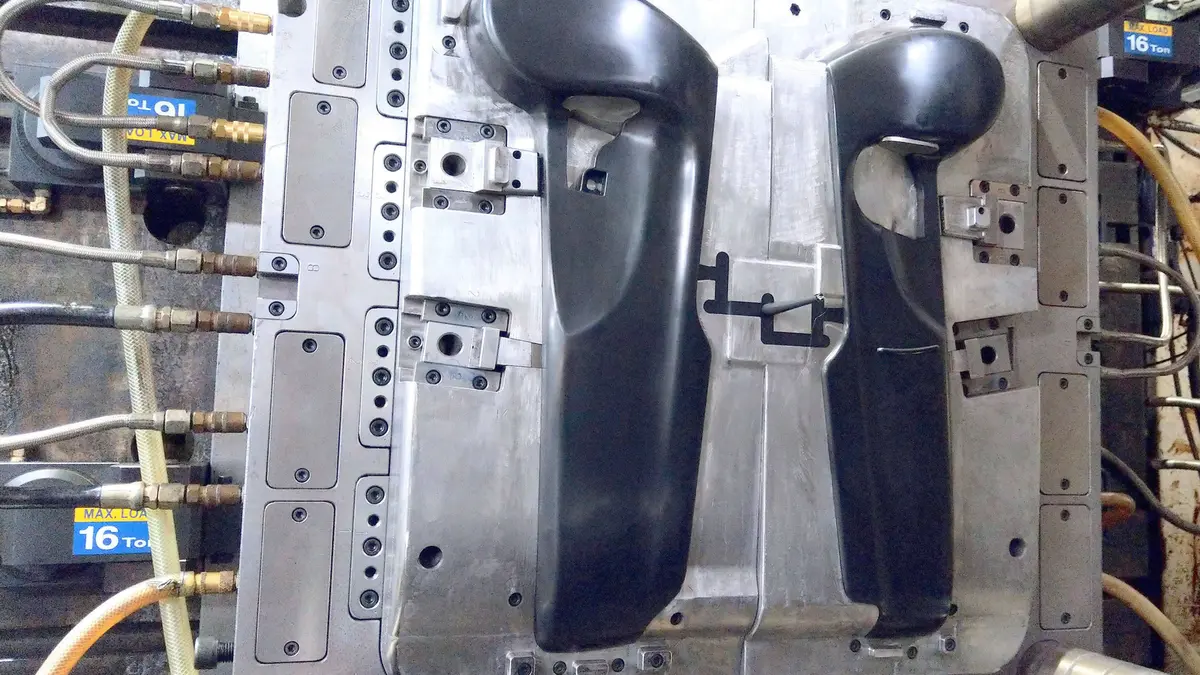
Controlling Warpage on Large Thin-Wall Parts
Armrest bases are typically molded in PP+EPDM-TD20 or PP-LGF30 (long glass fiber). Long-fiber compounds give the stiffness the console needs, but they shrink more and warp unpredictably if the mold is not balanced. Our DFM team runs mold-flow analysis before cutting steel, placing the gates so the melt front meets in the hidden areas, and we correct shrinkage in the cavity by iteration during tool trials — a process that is only practical when tooling and molding are tuned by one accountable team. We also add countermeasure ribs on the non-visible side to hold flatness to 0.3 mm over 500 mm, which is what the lid seal requires.
The class-A surface is produced directly out of the tool: the cavity is polished to SPI A-1/A-2 and the part runs with a controlled mold temperature (often 40-60°C for PP compounds) so the surface replicates the steel finish. No paint, no film — the grain or gloss comes from the tool, which is why the first-shot surface check is non-negotiable. published automotive benchmarks show the same approach — parts tolerance of ±0.1 mm and mold tolerance of ±0.05 mm on interior components such as door handles (and we hold comparable or tighter numbers on the armrest base.
Assembly Fit and Program Management
The armrest base rarely ships alone. It carries the hinge, the cup holders, sometimes an armrest lid skin in two-shot or overmolded TPU, and the electrical harness clips. Because MOLDITQUICK has overmolding and insert molding on the same molding floor, the hinge pins and harness inserts are molded in the same facility as the base, and the assembly fit is checked with the actual mating parts — not with nominal CAD values. Cpk of 1.33 or better is required on the hinge-bore position and the mounting-bolt pattern, and we document it in the PPAP submission.
Volumes for console programs typically run 100,000-500,000 pieces per year across variants. We deliver multi-cavity tooling and run it on our presses with automated take-out; changeovers between left/right or option variants take minutes because the tooling is designed for quick cavity swaps. The 10,000 m² facility and 280-person team in Dongguan handle molding, CNC and finishing in our workshops, with tooling delivered through our audited tooling partner network, plus global shipping with 7-12 day low-volume and 25-30 day production lead times.
If your console program is fighting warpage, sink on the class-A surface or hinge-fit issues, send us the part files and the DV/PV test requirements. We will give you a DFM review with mold-flow results before you commit to tooling. Contact us to start, or browse our case studies.
Need a quote? Contact us — upload your 3D file for a fast DFM review.
NEXT STEP
Ready to Start Your Project?
Send us your requirements — our team responds within 24 hours with pricing and lead time.
Written by
Ray ChanManufacturing Engineer · Custom Manufacturing Specialist. Ray helps global importers and integrators source factory-direct plastic parts and tooling.