
Insert Molding Manufacturer: Terminals Locked in Place
Table of Contents
Insert molding is the process of placing a metal part — a brass terminal, a steel bushing, a threaded nut — into the mold cavity and molding plastic around it, so the metal is locked in place by the plastic itself. The manufacturing discipline is brutal: the insert must stay positioned within ±0.02 mm while molten plastic flows around it at 200-280°C, and the molded part must survive thermal cycling without cracking around the metal.
MOLDITQUICK is an insert molding manufacturer serving connector, automotive and appliance customers. We run automated vertical molding cells where the insert is loaded, the shot is taken, and the finished part is ejected in one cycle, and we engineer the automation and tooling as one system so the insert handling is consistent shot to shot. Our vertical presses run alongside our horizontal machines, giving us the full range for both insert and standard molding.
Terminal Retention: The Physics of a Good Insert Mold
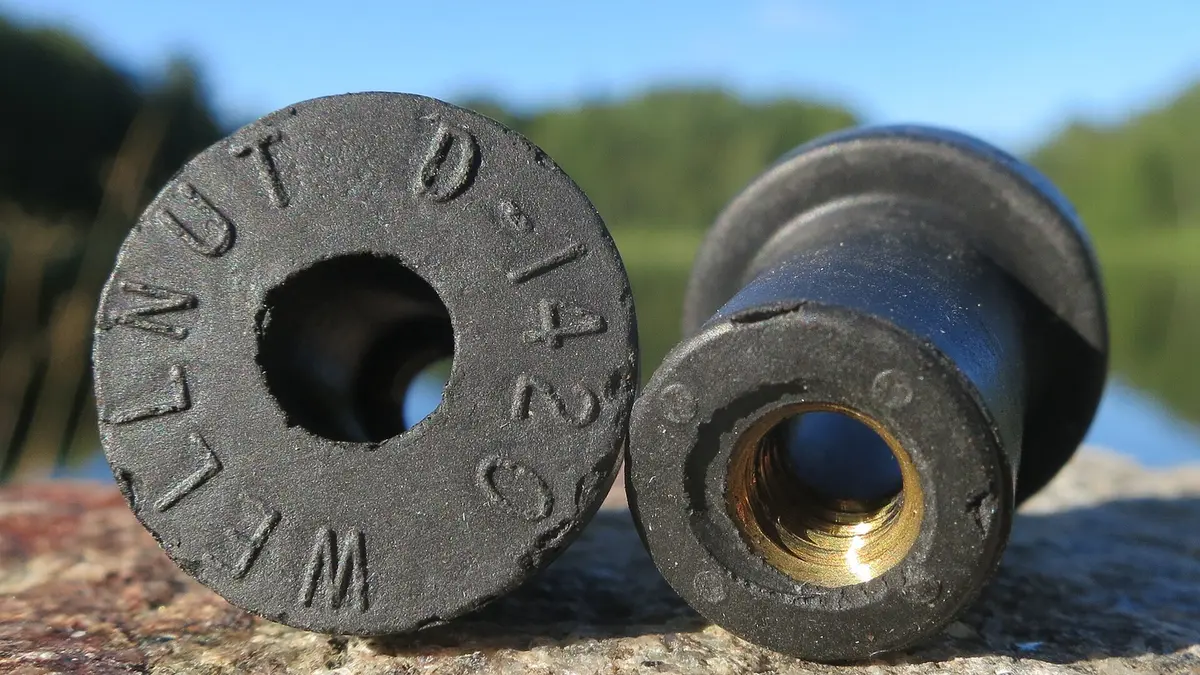
Holding a brass terminal to ±0.02 mm through the shot is not a matter of clamping hard — it is a matter of controlling the forces. The plastic shrinks as it cools, and it shrinks onto the insert, which is exactly what creates the retention force. The design rules: the insert surface should be knurled, undercut or otherwise mechanically roughened so the shrinkage locks in; the plastic wall around the insert must be thick enough to avoid sink marks; and the mold must carry the insert on a hardened core pin that resists the melt pressure without deflecting. If the pin flexes 0.03 mm under a 600-bar packing pressure, every part is scrap before it is made.
CTE mismatch is the second trap: metal expands and contracts at roughly a third of the rate of plastic, so a molded-in bushing in a part that sees 85°C will try to push the plastic apart. The fix is design geometry — radiused transitions, adequate wall, and sometimes a soft intermediate layer — which is exactly what our insert molding guide covers in detail.
Automation, Volumes and the Vertical Press Advantage
For high volumes, insert loading becomes the bottleneck, so we automate: vibratory bowl feeders position the inserts, a pick-and-place robot loads them into the vertical press, and the molded part is removed automatically. A typical connector program runs 4-8 cavities with a cycle of 25-40 seconds, producing 100,000-2 million parts per year. The vertical press layout is what makes this reliable — inserts drop in vertically, gravity helps them seat, and the mold closes without disturbing the insert position.
We also combine insert molding with overmolding and two-shot when the part needs a seal or grip over the insert. All programs ship with dimensional reports on the critical insert positions, and we hold Cpk ≥ 1.33 on safety-relevant features under IATF 16949. Low-volume insert molding runs are quoted in 7-12 days; production runs in 25-30 days, from our 10,000 m² Dongguan facility.
If your connector, bushing or terminal program is fighting insert shift, cracked plastic or supplier inconsistency, send us the part and insert drawings. We will review the retention design and quote the tool. Contact us to start.
The economics of insert molding deserve a look before you commit: the insert itself is a purchased part, the loading automation is part of the tooling, and the cycle is typically longer than a standard shot because the insert must be placed and held. Against that, you eliminate the secondary assembly operation, the tolerance stack of press-fitting, and the field failure mode of a loose terminal. For quantities above roughly 50,000 parts per year, molded-in inserts are almost always the cheaper total-cost answer; below that, heat-staked or ultrasonic post-molding insertion may win. We quote both paths so the decision is based on your volume, not our capability.
Need a quote? Contact us — upload your 3D file for a fast DFM review.
NEXT STEP
Ready to Start Your Project?
Send us your requirements — our team responds within 24 hours with pricing and lead time.
Written by
Ray ChanManufacturing Engineer · Custom Manufacturing Specialist. Ray helps global importers and integrators source factory-direct plastic parts and tooling.